Thirty minutes of walking in Lisbon is not the same as thirty minutes in a flat city. We notice it every day: a dog who trots happily for an hour along the river comes home from Graça or Alfama after half that time and goes straight to sleep.
That is not your dog being lazy. Lisbon is built on seven hills, and walking up and down them is real work.
What a hill does to your dog's body
Dogs carry more of their weight on their front legs than on their back legs. On flat ground that balance works well. On a slope it shifts.
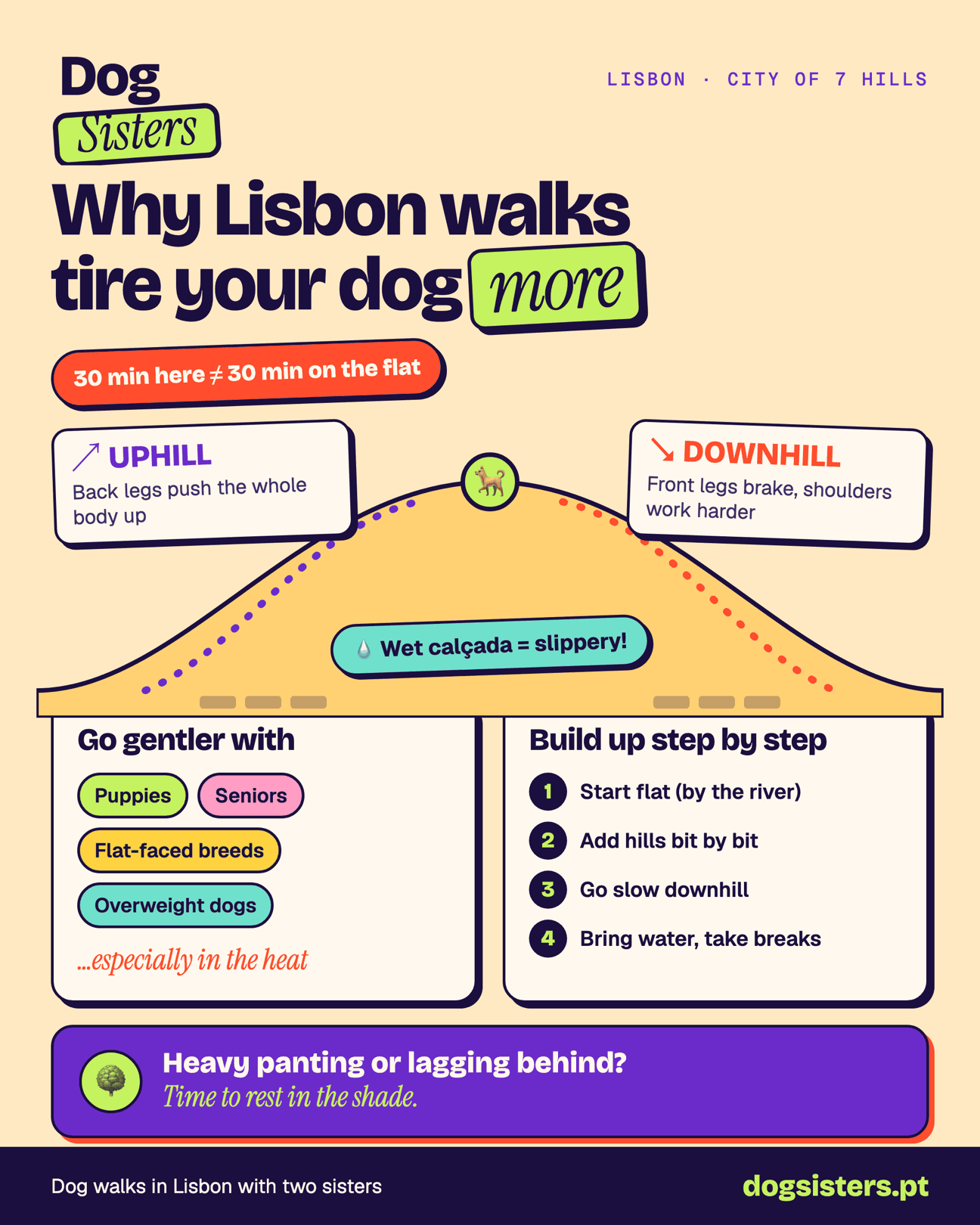
Going uphill, the back legs do the pushing. They drive the whole body up the street, step after step. A study that filmed dogs walking uphill found their hip and stifle (knee) joints move differently than on the flat: the back end is doing the heavy lifting.
Going downhill, the front legs do the braking. Research on dogs trotting down a slope found their legs do almost nothing but brake. And because a dog carries more weight up front, a lot of that braking lands on the front legs, shoulders and elbows, even though downhill feels "easier" to us.
And then there is the calçada. Lisbon's beautiful limestone pavements are smooth and polished by years of feet. When they are wet, they get slippery. A dog who is braking downhill on wet stones has to work even harder to stay steady.
Which dogs need it gentler
Most healthy adult dogs can learn to love Lisbon's hills. Some need a softer start:
| Dog | Why | What helps |
|---|---|---|
| Puppies | Their joints are still growing | Short, mostly flat walks, lots of sniffing; ask your vet how much is right |
| Senior dogs | Stiffer joints, less muscle | Gentle slopes, slow descents, more breaks |
| Flat-faced breeds (Frenchies, pugs, bulldogs) | They overheat and run out of breath faster | Cool hours only, short climbs, shade |
| Dogs carrying extra weight | More load on every joint | Build up slowly; flat routes first |
Heat makes everything harder. A large UK study of over 900,000 dogs under veterinary care found that exercise triggered about three in four cases of heat-related illness, and flat-faced dogs were at higher risk. In Lisbon that means: in summer, do the hills early in the morning or after sunset, never at midday.
How to build up to the steep streets
Think of hills like training for a run. You would not start with the steepest climb.
- Start flat. Begin with the river: Ribeira das Naus, the Belém waterfront or Parque das Nações. Let your dog get fit on easy ground first.
- Add hills bit by bit. Add one gentle slope to your usual walk, then two. Save the really steep streets (Bica, Graça, the Alfama stairs) for when your dog copes easily.
- Go slow downhill. This is where the front legs and shoulders work hardest. Shorten the lead, slow down and let your dog pick their footing.
- Bring water and take breaks. A short stop in the shade halfway up does more good than pushing through.
- Watch the next day. If your dog is stiff, slow to get up or reluctant on the stairs the morning after, the walk was too much. Scale back and build up again.
Mixing hills and flat across the week
You do not need to avoid hills. Mixed walks keep dogs fit, curious and happy, and they are part of what makes Lisbon so good for dogs. The trick is balance: a hilly walk one day, a flat sniff-and-stroll by the river the next.
That is how we plan our own dog walks in Lisbon. We know which streets are steep, which gardens have shade, and which routes suit a puppy or an older dog. We walk at your dog's pace, not ours, and we pick your dog up at your door. Curious where we go? Have a look at where we roam.
Planning a trip with your dog? Our dog-friendly Lisbon itinerary has flat and hilly options for every day.
Questions owners ask us
Is Lisbon a good city for walking a dog?
Yes, as long as you plan around the hills and the weather. There are long flat stretches by the river (Ribeira das Naus, Belém, Parque das Nações) and shady gardens like Estrela, so you can mix easy and steep walks across the week.
How long should a walk on Lisbon hills be?
Shorter than the same walk on flat ground. Start with a shorter hilly route than your usual flat walk, watch how your dog recovers the next day, and build up from there. For puppies, ask your vet how much exercise is right for their age.
Is calçada bad for dog paws?
Calçada is not harmful in itself, but it gets slippery when wet and very hot in summer sun. Slow down on wet stones, avoid steep polished streets after rain, and test the stones with the back of your hand on hot days.
My dog is old. Should we avoid hills completely?
Not necessarily. Many older dogs enjoy a gentle slope. Keep it short, go slowly downhill, take breaks and talk to your vet if your dog has joint problems or stiffness after walks.
Want us to take the hills?
We walk dogs across Lisbon every day, at a pace that suits your dog, with door-to-door pick-up.
See dog walking →Sources
- Holler et al. (2010), Kinematic motion analysis of the joints of the forelimbs and hind limbs of dogs during walking exercise regimens, American Journal of Veterinary Research (accessed 2026-11-13)
- Lee (2011), Effects of grade and mass distribution on the mechanics of trotting in dogs, Journal of Experimental Biology (accessed 2026-11-13)
- Hall, Carter & O’Neill (2020), Dogs Don’t Die Just in Hot Cars: Exertional Heat-Related Illness (Heatstroke) Is a Greater Threat to UK Dogs, Animals (accessed 2026-11-13)