Chewed shoes again. A hole in the garden, or the sofa cushion in pieces. A dog who barks at every sound, paces from room to room and just will not lie down. These are some of the most common signs your dog is bored, and owners in Lisbon ask us about them often.
But they are not always about boredom. The same behaviour can come from stress or from pain. So before you add more walks, it is worth working out what your dog is really telling you.
Signs your dog is bored or under-stimulated
Chewing, digging and scratching are normal dog behaviours. The UK dog charity Dogs Trust is clear on that: they are not "bad" or "naughty". They become a problem when they happen a lot, in the wrong places, because a need is not being met.
Here is what to look out for, and what it can mean:
| What you see | It can mean | Worth checking |
|---|---|---|
| Chewing shoes, furniture, cushions | Boredom, stress or discomfort | Does your dog have things they are allowed to chew? |
| Digging at the garden, sofa or bed | A natural behaviour with no other outlet | Do they get to sniff and dig somewhere suitable? |
| Barking or whining a lot | Frustration, worry, nothing else to do | When does it happen: alone, at night, after walks? |
| Pacing, not settling, always on alert | Boredom, overtiredness, or pain | Is it new? Is your dog stiff or sore anywhere? |
Dogs Trust describes restlessness at home in exactly these terms: pacing, whining, barking or chewing things. It also notes that boredom can make it hard for a dog to settle.
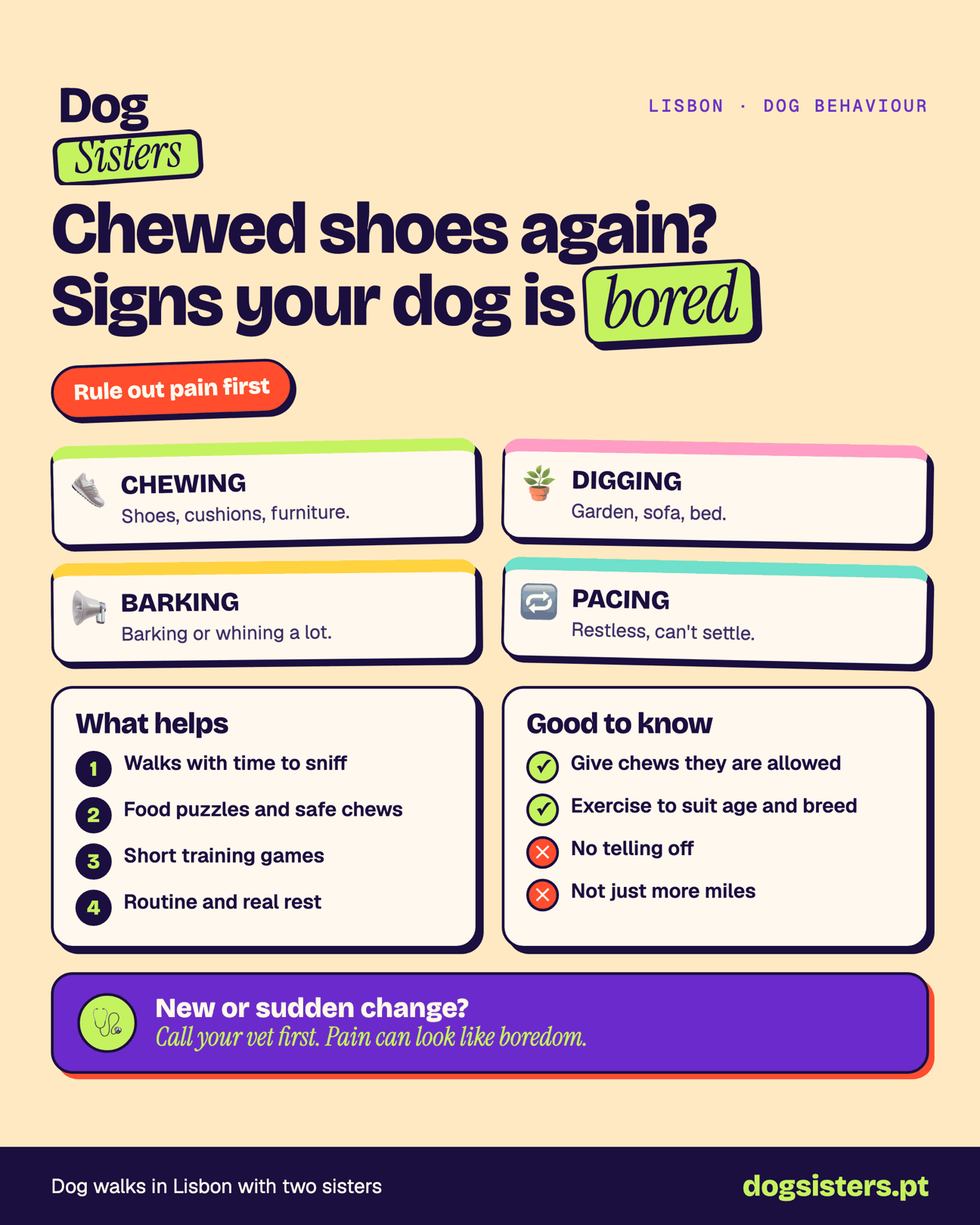
First, rule out pain
This step is easy to miss. A dog in pain cannot tell you where it hurts, so it shows you in other ways.
Dogs Trust lists pain, injuries and allergies among the possible causes of destructive behaviour, and says pain or physical discomfort can make it hard for a dog to settle. Its advice is to book a check with your vet if your dog's behaviour has recently changed.
Research points the same way. In a 2020 review, a group of veterinary behaviourists looked back at their own recent caseloads and estimated that around a third of the dogs referred to them for behaviour problems had some form of painful condition. Joint and muscle problems were common, but painful stomach and skin conditions came up too.
So if the chewing, barking or pacing is new, or started suddenly, call your vet first. A sudden change is a reason to look for a cause, not just to add more walks.
What actually helps: variety, not just more miles
If your vet is happy, think about what your dog's week looks like, not just how far they walk. More exercise is not always the answer. Dogs Trust points out that a dog who has had too much exercise and is overtired can struggle to rest too, and that most adult dogs need 12 to 14 hours of sleep a day.
What helps most dogs:
- Exercise that fits your dog. Walks and play that suit their age, health, breed and size. A young working breed and an older lapdog need very different days.
- Time to sniff. Slow down and let your dog read the street. In one study, pet dogs that did a daily nosework activity for two weeks became more "optimistic" in a test of their mood, while dogs that practised heelwork did not change.
- Brain work at home. Food puzzles, safe chews, short training sessions and sniffing games. Feeding some of the daily food this way turns mealtime into a job.
- Something they are allowed to chew. Offer chews and puzzle feeders, and reward your dog when they choose them over your shoes.
- A predictable routine, and real rest. Many dogs feel safer with a steady routine. Teach a calm "settle" on a mat or bed, and protect their sleep.
A bigger day out, once or twice a week
For many city dogs, the missing piece is not another lap of the block. It is a day with new smells, new ground and other dogs to walk beside.
That is what our pack walks near Lisbon are for. On Tuesdays and Thursdays, from 9:30 to 14:30, we take a small pack, matched by temperament, to beaches, forests and lakes outside the city, with smell games and training along the way. We pick your dog up at the door and bring them home tired in the good way.
Between journeys, our dog walks in Lisbon keep the routine going, at your dog's pace, with plenty of time to sniff.
Questions owners ask us
How do I know if my dog is bored or just has lots of energy?
Often you cannot tell from the behaviour alone. Boredom, too much exercise and pain can all make it hard for a dog to settle. If the behaviour is new, see your vet first; then look at how varied and restful your dog’s week really is.
Is more exercise always the answer?
No. Exercise should suit your dog’s age, health, breed and size, and an overtired dog can find it just as hard to rest. Variety, sniffing time, brain games and a calm routine often help more than extra miles.
When should I call the vet about my dog’s behaviour?
When the behaviour is new or has changed suddenly, or when your dog seems uncomfortable, stiff or unwell. Pain and illness can show up as restlessness or chewing, so a vet check comes first.
Should I tell my dog off for chewing things?
No. Punishment can make a worried dog more anxious and does not fix the reason behind the chewing. Give them something they are allowed to chew, and reward them when they use it.
Want us to take the hills?
We walk dogs across Lisbon every day, at a pace that suits your dog, with door-to-door pick-up.
See dog walking →Sources
- Dogs Trust, Helping a hyper or restless dog to calm down (accessed 2026-11-13)
- Dogs Trust, Destructive behaviour in dogs: how to stop it (accessed 2026-11-13)
- Mills et al. (2020), Pain and Problem Behavior in Cats and Dogs, Animals (accessed 2026-11-13)
- Duranton & Horowitz (2019), Let me sniff! Nosework induces positive judgment bias in pet dogs, Applied Animal Behaviour Science (accessed 2026-11-13)