You are halfway down a narrow street in Alfama. Parked cars on one side, a wall on the other, and a dog you do not know is coming straight towards you. Passing other dogs on walks is part of daily life in Lisbon, and on pavements this narrow it can feel like there is nowhere to go.
There almost always is. A few simple habits make these moments calmer for your dog, for the other dog and for both owners.
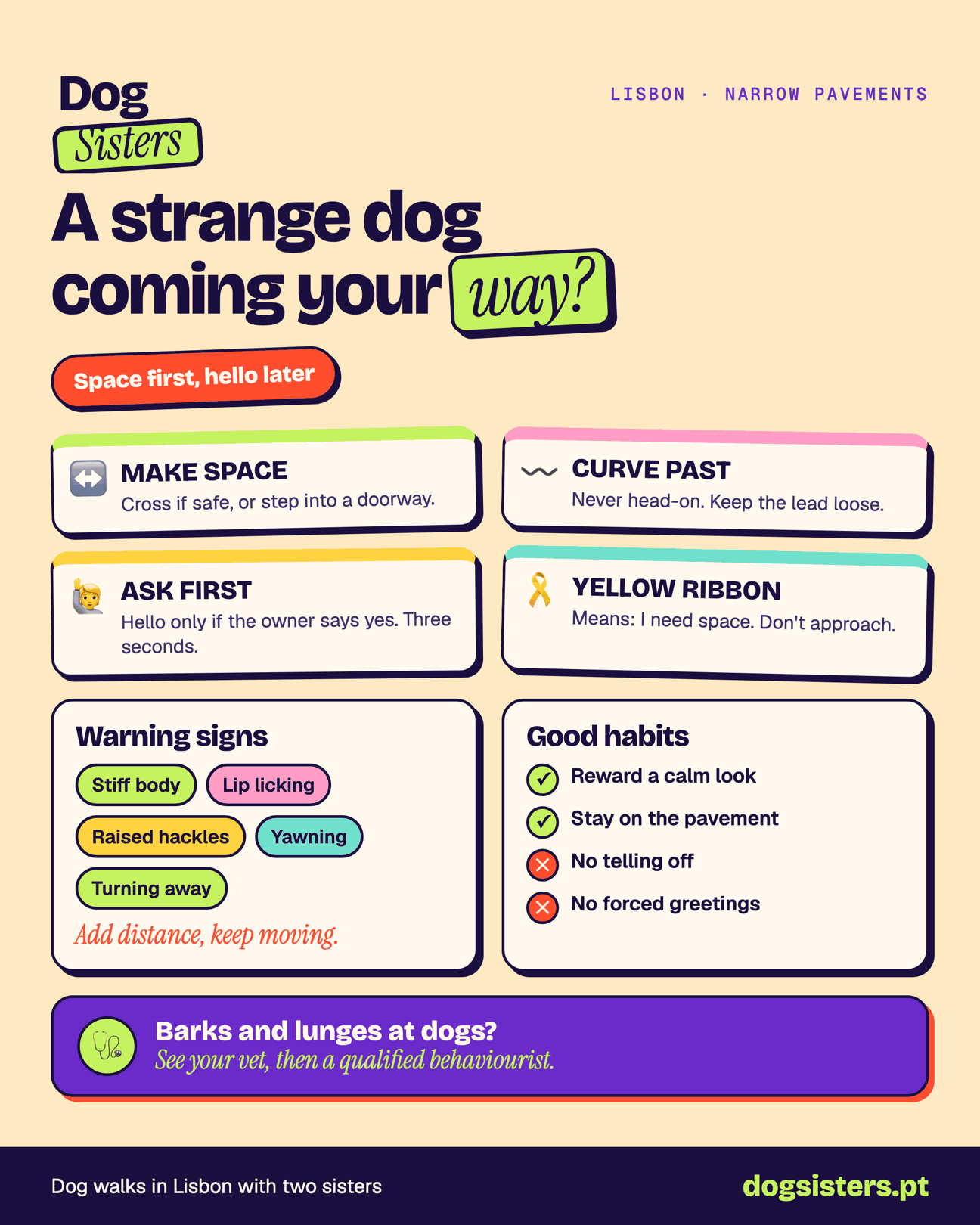
Passing other dogs on walks: make space first
Dogs feel more relaxed when they have room. The best moment to act is early, before the other dog is close.
- Look ahead. As soon as you see a dog coming, decide what you will do.
- Cross the road if it is safe. Dogs Trust suggests crossing over or changing direction to give other dogs space early.
- Or step aside. A doorway, a wider bit of pavement or a small square gives both dogs room. Stay on the pavement, never step out into traffic.
- Keep moving. Let the other dog pass, then carry on.
Curve past, never head-on
Walking straight at another dog can feel confrontational. Battersea, the London rescue charity, notes that sociable dogs tend to approach each other side-on, in an arc, not head-on. You can copy that on the pavement: bend your path slightly so you pass in a gentle curve, not straight at them.
Keep the lead loose. Battersea describes loose-lead walking as your dog being comfortable and not pulling. Stay close to your dog, so you can calmly call them away if you need to.
Want to say hello? Ask first
Some dogs love to meet, many do not, and you cannot tell which from across the street. Battersea's advice is clear: always check with the other owner before your dog says hello, even if your own dog is friendly.
If they say yes and both dogs look relaxed, keep it short. Battersea suggests a "three-second rule": let the dogs sniff for about three seconds, then call your dog away and carry on. Praise your dog for coming with you.
If the owner says no, that is fine. Give their dog as much room as you can.
The warning signs to watch
Dogs tell us a lot before they ever growl or bark. These are some of the signals Dogs Trust describes:
| What you see | What it can mean | What to do |
|---|---|---|
| Stiff, tense body, slowing or freezing | The dog is worried by what it sees | Create distance calmly, keep moving |
| Lip licking (with no food around) | Anxiety | Give more space |
| Yawning when not tired, head turned away | Stress, avoiding a direct stare | Don't push a greeting |
| Raised hackles | High arousal the dog cannot control | Look at the whole body, add distance |
Raised hackles are not automatically aggression. Dogs Trust describes them as a physical response to high stimulation that the dog cannot control, so check the rest of the body. Either way, it is a sign to give more room, not less. If you see these signals in either dog, calmly walk your dog away.
The yellow ribbon
You may see a yellow ribbon, bandana or lead cover on a dog. It is a voluntary signal, promoted by the charity Yellow Dog UK, that says: this dog needs space. The dog might be nervous, reactive, recovering from injury or surgery, or in training.
If you see one, do not approach with your dog and do not reach out to pet them. Give them room and time to pass. It is not a legal rule and not every owner knows it, so do not rely on it alone. But if your own dog needs space, it is an easy way to ask for it.
Reward the calm look
Here is the part that changes walks over time. When your dog sees another dog and simply looks, calmly, then looks back at you: reward that. A treat, a kind word, and keep walking.
Dogs Trust's advice is to reward calm behaviour when you see it, and to avoid telling your dog off, which can increase stress and make things worse. Battersea also recommends rewarding all calm behaviour around other dogs. Over time, calm passes can help your dog learn that other dogs are nothing to worry about.
Walking in Lisbon, one calm pass at a time
Lisbon's narrow pavements are not going anywhere, so it helps to have a plan. On our dog walks in Lisbon we walk on the lead and at your dog's pace, one-to-one or in a small group, and we pick your dog up at your door.
If your dog finds the busy centre hard, our dog-friendly Lisbon itinerary has calmer options along the river and in Monsanto.
Questions owners ask us
Should I let my dog greet every dog we pass?
No. Always ask the other owner first, and only let the dogs greet if both look relaxed. If the owner says no, give their dog as much room as you can, even if that means crossing the road.
What does a yellow ribbon on a dog’s lead mean?
It is a voluntary signal, promoted by the charity Yellow Dog UK, that the dog needs space. It might be nervous, recovering from an injury, in training or simply not keen on close contact. Do not approach, and give them room to pass.
Are raised hackles always a sign of aggression?
No. Raised hackles show high arousal that the dog cannot control, which is not necessarily aggression. Look at the whole body and give the dog more space.
My dog barks and lunges at other dogs. What should I do?
Keep more distance on walks, reward calm moments and avoid telling your dog off. Then talk to your vet, to rule out pain or illness, and ask about a qualified behaviourist who can build a plan for your dog.
Want us to take the hills?
We walk dogs across Lisbon every day, at a pace that suits your dog, with door-to-door pick-up.
See dog walking →Sources
- Battersea, How to introduce your dog to other dogs on walks (accessed 2026-11-13)
- Dogs Trust, How to understand your dog’s body language (accessed 2026-11-13)
- Dogs Trust, Reactive dogs: why it happens and how to help (accessed 2026-11-13)
- Yellow Dog UK, Support and awareness for nervous and anxious dogs who need space (accessed 2026-11-13)